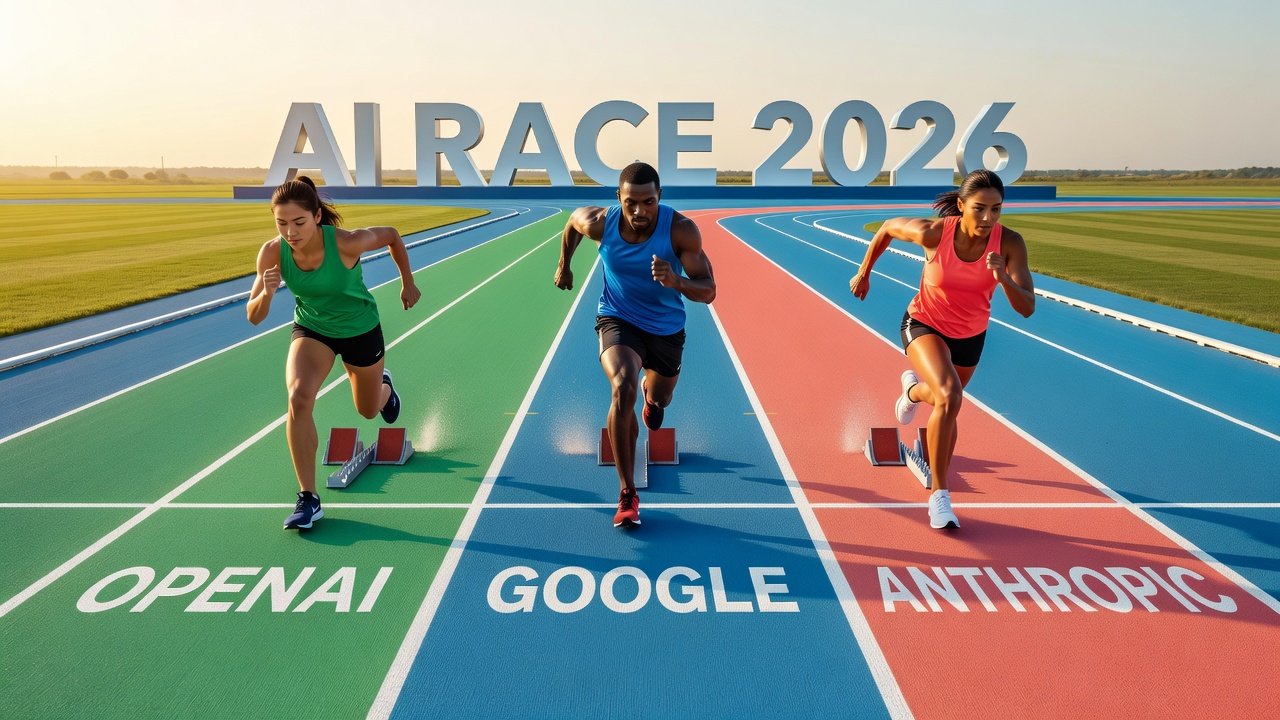
The artificial intelligence industry is witnessing an extraordinary competition among three titans: OpenAI, Google, and Anthropic. Each company brings distinct philosophies, massive financial backing, and breakthrough technologies to the table. While OpenAI pioneered the consumer AI revolution with ChatGPT, Google leveraged decades of research expertise, and Anthropic emerged as the safety-focused challenger. Understanding their strategies, capabilities, and backing reveals not just who's winning today, but who's positioned to shape how AI integrates into our daily lives. This race isn't just about building smarter models - it's about defining the future of human-computer interaction and determining which vision of responsible AI development prevails.
The Players and Their Origins
OpenAI started in 2015 as a non-profit with an idealistic mission: ensure artificial general intelligence benefits all of humanity. The initial structure didn't last long. By 2019, the computational demands and talent costs forced a restructuring into a hybrid model, eventually becoming a public benefit corporation. This shift allowed OpenAI to attract serious capital while theoretically maintaining its mission-driven focus. Microsoft saw the potential early, pouring over $13 billion into the partnership and securing exclusive rights to commercialize OpenAI's technology for businesses while serving as its sole cloud provider.
Google took a different path. After years of running parallel AI efforts, the company merged its internal Google Brain division with DeepMind, the UK-based startup it acquired, in April 2023 to form Google DeepMind. This consolidation signaled Google's recognition that fragmented efforts weren't enough to compete. With decades of machine learning research, massive datasets from Search and YouTube, and infrastructure that already powered billions of users, Google entered the consumer AI race with advantages others couldn't match.
Anthropic represents the philosophical divergence within AI development. Founded in 2021 by former OpenAI researchers Dario and Daniela Amodei, the company emerged from strategic disagreements about AI safety and commercialization. The siblings and their team believed AI development needed stronger safety guardrails and different priorities. Amazon recognized this vision's value, investing $13 billion by July 2026 and making AWS Anthropic's primary cloud provider. Beyond the direct investment, Amazon committed over $100 billion to AWS cloud infrastructure over the next decade, creating a foundation for Anthropic's ambitious roadmap.
AI Snapshot: Microsoft invested over $13 billion in OpenAI while Amazon matched that with $13 billion in Anthropic, making these partnerships the largest AI investments in history and cementing the cloud providers' roles in the AI race.
Technology and Approach: Different Philosophies in Action
OpenAI's GPT models changed public perception of what AI could do. ChatGPT wasn't the first chatbot, but it was the first that felt genuinely useful for everyday tasks. The company's approach prioritizes rapid iteration and public deployment. You see this in how quickly GPT-3.5 gave way to GPT-4, and how OpenAI continuously rolls out new features like DALL-E integration, voice capabilities, and custom GPTs. This velocity creates market momentum but raises questions about rushing powerful technology to market.
Google DeepMind brings a research-first mentality combined with product integration across the world's most-used services. Gemini, Google's flagship AI model, powers everything from Search summaries to Gmail composition suggestions. The technical capabilities often match or exceed competitors, but Google faces a unique challenge: implementing AI without disrupting the advertising-based business model that generates most of its revenue. When your AI gives direct answers, people click fewer ads. This tension shapes every product decision.
Anthropic positions Claude as the thoughtful, safety-conscious alternative. The company publishes extensive research on AI alignment and interpretability - understanding how models actually make decisions. Claude's Constitutional AI approach attempts to build safety principles directly into training rather than adding guardrails afterward. In practice, this means Claude sometimes refuses requests other models accept, and provides more nuanced responses about controversial topics. Users either appreciate this careful approach or find it frustrating, depending on their priorities.
Business Models and Market Strategy
OpenAI pursued aggressive monetization through ChatGPT Plus subscriptions and enterprise partnerships. The consumer subscription at $20 monthly proved people would pay for AI access, generating substantial recurring revenue. Meanwhile, Microsoft integration brought OpenAI's technology into Office 365, GitHub, and enterprise tools used by millions of workers daily. This two-pronged approach - direct consumer sales plus platform partnerships - creates multiple revenue streams and reduces dependence on any single channel.
Google's strategy leverages existing scale. Rather than charging separately for AI features, Google integrates them throughout its ecosystem. You get AI-powered Search results, smarter Gmail, improved Google Workspace tools, and enhanced Assistant capabilities. The company also offers enterprise AI through Google Cloud Platform, competing directly with Microsoft and Amazon for business customers. Google's advantage lies in existing relationships: companies already using Google services face lower switching costs for AI features than adopting entirely new platforms.
Anthropic targets a different segment: customers who prioritize safety, reliability, and transparency. Large enterprises handling sensitive data - healthcare providers, financial institutions, legal firms - often value these characteristics over raw capability or speed. Claude's APIs serve developers who want capable AI without constantly worrying about unexpected behavior or harmful outputs. This positioning creates a niche, but potentially a highly valuable one as AI adoption expands into regulated industries with strict compliance requirements.
What This Competition Means for Users
Competition drives rapid improvement. Each major model release from one company prompts responses from the others, accelerating development cycles. We've seen models become more capable, cheaper to use, and better at specialized tasks in months rather than years. This pace benefits users directly - you get better tools faster than if a single company dominated without pressure.
The philosophical differences create meaningful choices. If you want the latest features and maximum capability, OpenAI often leads. If you need deep integration with productivity tools you already use, Google provides the smoothest experience. If safety and careful responses matter most, Anthropic offers that focus. These aren't just marketing positions - they reflect genuine strategic differences that affect how you'll interact with each system.
The financial backing determines staying power. AI model training costs millions to billions of dollars per model generation. Only companies with massive capital can sustain this spending long-term. Microsoft's investment in OpenAI, Google's own resources, and Amazon's backing of Anthropic ensure all three players can continue competing. Smaller companies without comparable funding will struggle to keep pace, likely consolidating around these three ecosystems or finding narrow specialized niches.
Conclusion
The AI race among OpenAI, Google, and Anthropic represents more than corporate competition - it's a fundamental contest over what role AI plays in society and who controls that transformation. OpenAI's consumer-first approach, Google's integration strategy, and Anthropic's safety focus each offer distinct visions for AI's future. The massive investments from Microsoft and Amazon ensure this competition continues for years, driving innovation while raising important questions about concentration of AI power among a few well-funded players. Your choice of which AI tools to use isn't just about features or performance today. It's about which company's approach to AI development, safety, and deployment aligns with your values and needs. The competition remains intense because the stakes - shaping how billions of people interact with information and technology - couldn't be higher. Watch how each company balances capability with responsibility, speed with safety, and profit with their stated missions. Those trade-offs will determine which vision of AI's role in our lives ultimately prevails.
FAQs
Which AI company has the most advanced technology right now?
The answer depends on what you measure. OpenAI's GPT-4 excels at general reasoning and creative tasks. Google's Gemini shows particular strength in multimodal understanding - combining text, images, and other data types. Anthropic's Claude offers superior performance on tasks requiring careful ethical reasoning. Each company leads in different capabilities, and rankings shift with each model release. Rather than a single winner, we have specialized strengths across competitors.
How do Microsoft's and Amazon's investments affect these AI companies?
These partnerships provide more than just funding. Microsoft's $13 billion investment in OpenAI and Amazon's matching $13 billion in Anthropic include exclusive cloud infrastructure deals that reduce operating costs while locking in technical dependencies. Microsoft gains priority access to OpenAI's technology for products like Office 365, while Amazon integrates Claude into AWS services. These arrangements create strategic alignment where success depends on both partners, fundamentally shaping each AI company's product roadmap and market positioning.
Why did Anthropic's founders leave OpenAI?
Dario and Daniela Amodei departed OpenAI in 2021 due to strategic differences over AI safety approaches and commercialization priorities. The siblings believed AI development needed stronger safety research and different organizational structures to ensure responsible development. They founded Anthropic specifically to pursue their vision of AI alignment and Constitutional AI - methods that build safety principles into models from the start rather than adding restrictions afterward. This split reflects genuine philosophical disagreement within the AI research community about the best path forward.
Can smaller AI companies compete with these three giants?
Direct competition on general-purpose AI models becomes increasingly difficult as training costs escalate into billions of dollars per model generation. However, smaller companies succeed by specializing - building AI for specific industries, use cases, or languages that giants overlook. Open-source models also create opportunities for companies that fine-tune existing technology rather than training from scratch. The future likely includes a few dominant general AI platforms alongside many specialized providers serving niche markets the giants can't efficiently address.
Author

Maya-Rodriges@foucheres.com
Related Posts
Voice AI Is Finally Good: Where It Actually Works
Voice AI has crossed the accuracy threshold. Discover where voice AI actually works now - from customer service to healthcare - and...
Read out all
OpenAI Agents API: Build AI Agents With Sessions
OpenAI's Agents API launched Sept 2026 with managed sessions, automatic context compaction, and flexible deployment for building long-running AI agents.
Read out all
Is AI Search Replacing Google? What the Numbers Say
Is AI search replacing Google? We analyze market share, usage patterns, and 2026 data to reveal what's really happening in the search...
Read out all
Slack Integrates AI Coding Agents Into Group Chat
Slack Code brings AI coding agents into team channels for collaborative development. Learn how this August 2026 launch changes software teamwork.
Read out all
Alibaba Qwen 3.8 27B: Vision, 262K Context, Apache 2.0
Alibaba's Qwen 3.8 27B delivers multimodal AI with vision processing, 262K token context, and Apache 2.0 licensing. Runs on consumer GPUs with...
Read out all
This Week in AI: Major Model Releases and What They Mean
Google Gemini 3.5 Flash, GPT-5, and Claude 4.5 Sonnet redefine AI in 2026. Explore autonomous agents, multimodal capabilities, and what these releases...
Read out all