
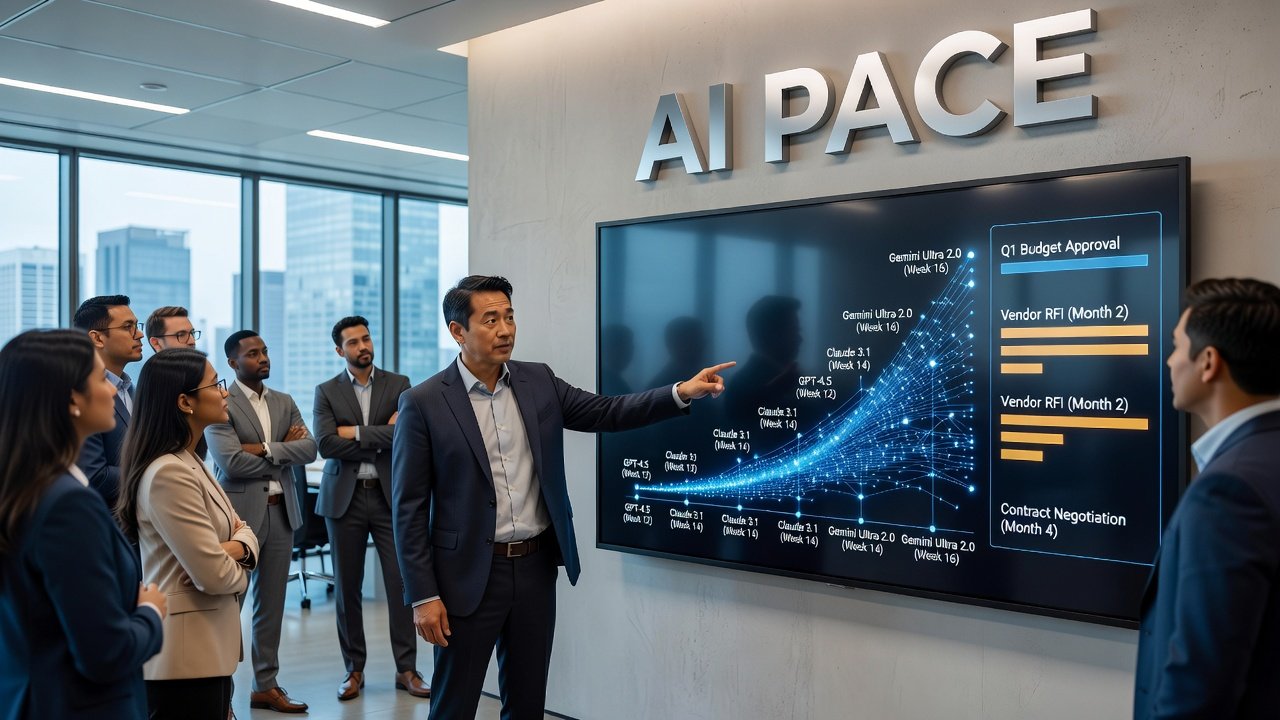
Companies used to plan for months before buying enterprise software. They'd run pilots, negotiate contracts, and lock in vendors for years. But AI changes that game entirely. New models drop every few weeks now, sometimes several in a single month. What was state-of-the-art in January feels outdated by March. This relentless pace is forcing businesses to rethink how they buy AI, turning what used to be a capital expense into something closer to a subscription treadmill. The question isn't just which model to pick anymore - it's whether to commit at all when the next release is already on the calendar.
The Speed Gap Between Model Releases and Enterprise Decisions
AI labs release new models every two to four months on average. That's a comfortable clip for a tech startup, but for enterprise procurement, it's chaos. Traditional enterprise buying cycles take four to nine months. By the time a company finishes evaluating a model, running security reviews, and getting budget approval, three newer versions have already shipped. The mismatch isn't subtle - it's a structural collision between how fast AI companies ship and how slowly big organizations buy.
This gap creates a strange new problem. Companies find themselves perpetually behind, not because they're slow to adopt, but because the finish line keeps moving. A procurement team that started evaluating GPT-4 in early discussions might find themselves signing contracts for a model that's already been superseded twice. The evaluation itself becomes stale before the ink dries. Some organizations respond by speeding up their process, cutting corners on vendor vetting or security review. Others just accept they'll always be one generation behind, which raises an uncomfortable question: if you're never on the latest version, does it even matter which one you pick?
AI Snapshot: In September 2025, an 8% monthly switching rate was observed among companies changing AI model providers, signaling that AI models are becoming commoditized faster than most enterprise software categories.
From Capital Investment to Recurring Expense
Buying AI used to look like buying server hardware. You'd budget for it once, deploy it, and use it for years. That model is dead. The rapid release cycle is pushing AI spending toward something closer to cloud computing: a recurring operational cost that never really ends. Companies can't treat a model as a durable asset anymore because it won't stay relevant long enough to justify that accounting treatment.
This shift hits finance teams hard. Capital expenses are easier to justify - you buy once, depreciate over time, and the cost is predictable. Operating expenses are different. They recur, they grow, and they compete with every other monthly cost. When you're paying for continuous model updates, API calls that scale with usage, and the infrastructure to switch between providers, the budget line starts to look less like software and more like utilities. Someone's always paying just to keep up, and that someone is usually the IT budget holder trying to explain why last quarter's AI spend just doubled.
The subscription treadmill also changes how companies think about ROI. You can't calculate return on investment the traditional way when the investment never stops. Instead, businesses are measuring AI spend as a percentage of revenue or comparing it to the cost of the human work it replaces. But even that math gets fuzzy when the model you're paying for this month might be obsolete by next quarter, forcing another evaluation cycle and potentially another vendor switch.
The Pilot Fatigue Problem
Here's a pattern playing out across industries: a company hears about a new model, kicks off a pilot, sees promising results, and then... nothing. The pilot stays a pilot. Six months later, a newer model comes out, and the cycle starts over. This phenomenon has a name now: pilot fatigue. Companies are stuck funding an endless parade of experiments without ever scaling anything into production. The rapid release cycle feeds this loop because there's always a reason to pause and wait for the next version.
The real cost isn't just the money spent on pilots that go nowhere. It's the opportunity cost of never committing. Teams burn time evaluating instead of implementing. They build proof-of-concepts that never touch customer workflows. And because leadership knows another model is coming soon, it's easier to delay a hard decision about scaling up. Why commit resources to integrating today's model when a better one might drop next month? The question sounds reasonable in a meeting, but it's a trap that keeps companies stuck in permanent evaluation mode.
What breaks the cycle? Some organizations are setting hard deadlines: pick a model, ship it to production, and commit to not re-evaluating for at least a year. That approach trades the fear of using an outdated model for the benefit of actually getting something done. Others are designing systems that make switching easier, investing in abstraction layers that let them swap models without rebuilding everything. Both strategies acknowledge the same truth - you can't optimize your way out of this. At some point, you just have to pick something and move forward, knowing it won't be perfect and it won't stay current.
Do You Even Need the Latest Model?
Here's the part that doesn't get said enough: for most business use cases, you probably don't need the absolute latest model. The newest releases grab headlines because they score higher on benchmarks or handle edge cases better, but plenty of real-world applications run fine on models that are six months or a year old. AI capability arrives faster than companies can actually absorb it, creating a gap between what's technically possible and what organizations can realistically deploy.
A customer service chatbot doesn't need the newest reasoning capabilities if it's just routing tickets and answering FAQs. A document classifier doesn't care if the latest model is better at creative writing. For many applications, the difference between generations is marginal, and the real bottleneck is integration, training data quality, or change management, not model performance. But the constant drumbeat of new releases creates psychological pressure to upgrade, even when the business case doesn't support it.
This realization is changing procurement conversations. Instead of asking "Which model is best?", companies are asking "Which model is good enough?" That's a harder question to answer because it requires understanding your actual requirements, not just reading benchmark scores. It also requires confidence to say no to the hype cycle and stick with something that works, even when competitors are announcing they've upgraded to the latest version. The companies that figure this out will spend less, ship faster, and waste less time chasing marginal improvements.
How Procurement Tools Are Adapting
The procurement software market is scrambling to keep up. Traditional tools like SAP Ariba and Coupa were built for a world where you bought enterprise software every few years, not every few months. They use AI for spend classification and optical character recognition (OCR), but they weren't designed for the rapid switching and continuous evaluation that AI procurement demands. That gap has opened space for new approaches.
Zip is one example of a newer model, purpose-built as a front-door orchestration layer in procurement. It automates the full intake-to-pay lifecycle, including routing requests, vetting suppliers, extracting contract data, and managing approvals. Instead of replacing existing ERP and procure-to-pay systems, it acts as an orchestration layer on top of them. The idea is to speed up the parts of procurement that slow down AI decisions - the endless approval chains, the vendor vetting, the contract review - without requiring companies to rip out their core financial systems.
These tools matter because they address a specific pain point: the administrative friction that turns a two-month AI evaluation into a nine-month procurement marathon. If you can automate the busywork - the forms, the approvals, the compliance checks - you can shrink the cycle time and get closer to matching the pace of model releases. But even with better tools, there's only so much you can compress. At some point, due diligence takes time, and no software can eliminate the need for humans to make judgment calls about vendor stability, data security, or strategic fit.
The Consumer Side: Trust and AI Shopping Agents
It's not just enterprises feeling the whiplash of rapid AI releases. Consumers are dealing with their own version of this problem, particularly around AI shopping agents. Tools like ChatGPT and Google Gemini are increasingly used for product research, but trust is still a major barrier. Only 22% of shoppers who use these tools trust AI shopping agents to actually make purchasing decisions for them. The rest are willing to use AI for research and comparison, but they want a human finger on the final buy button.
This trust gap mirrors what's happening in enterprise procurement, just at a different scale. Both consumers and businesses are experimenting with AI-assisted buying, but neither group is ready to fully delegate the decision. The rapid pace of model releases makes the trust problem worse because there's no time to build confidence in a particular system before it's replaced by a new one. You might start to trust ChatGPT for shopping advice, but then a new version ships with different behavior, and you're back to square one, testing whether it still gives good recommendations.
The pattern suggests that procurement - whether consumer or enterprise - requires stability in ways that AI development cycles don't naturally provide. People need time to learn a system, test its judgment, and develop confidence in its recommendations. When the system changes every few months, that trust never solidifies. This might be the most underappreciated cost of rapid AI releases: not the money or the time, but the erosion of confidence that comes from constantly rebuilding relationships with tools that won't stay consistent.
Conclusion
The pace of AI model releases has broken traditional procurement in ways that won't be fixed by just moving faster. Companies are caught between the pressure to stay current and the reality that constant upgrades drain budgets, scatter focus, and prevent anything from reaching production. The smart move isn't to chase every release or to ignore them all - it's to build procurement processes that acknowledge the speed of change without being paralyzed by it. That means shorter evaluation cycles, systems designed for easier switching, and the discipline to ask whether you actually need the latest version or if last quarter's model is already good enough. The real competitive advantage won't go to whoever adopts fastest, but to whoever figures out how to make consistent progress while the ground keeps shifting underneath them.
FAQs
How often are new AI models released?
Major AI models are now released every two to four months on average. Some periods see even faster releases, with seven significant model updates dropping in a single month during peak development cycles. This cadence is exponentially faster than traditional enterprise software, which typically releases major versions annually or less frequently.
Why do companies keep running AI pilots instead of scaling them?
Pilot fatigue happens because the rapid pace of new model releases creates a perpetual incentive to wait for the next version before committing resources to scale. Companies get stuck in a loop of experimentation without ever fully integrating AI into production workflows, burning budget on proof-of-concepts that never progress beyond testing phases.
Do businesses need to use the latest AI models?
Not usually. Most business applications work fine with models that are six months to a year old. The newest releases often improve benchmarks or handle edge cases, but core functionality for tasks like document processing, customer service automation, or data classification doesn't typically require cutting-edge performance. The gap between what new models can do and what companies can actually implement is often wider than the gap between model generations.
How is AI procurement different from traditional software buying?
Traditional software procurement assumes you're buying a stable product that will last years. AI procurement has to account for continuous updates, rapid obsolescence, and the possibility of switching providers frequently. This shifts spending from one-time capital investments to recurring operational expenses and requires processes designed for speed rather than just thoroughness.
Author

Maya-Rodriges@foucheres.com
Related Posts
From Pilot to Production: Making AI Stick at Work
Only 12% of AI pilots reach production. Learn why most AI projects fail to scale and how to design an AI implementation...
Read out all
Hidden Costs of Running AI in Your Business 2026
Hidden costs of AI can balloon to 200-300% beyond vendor quotes. Learn what businesses really spend on data prep, infrastructure, security, and...
Read out all
How Small Teams Use AI to Do the Work of Ten
Discover how small teams use AI tools to automate tasks, save hours daily, and compete with larger companies while staying lean and...
Read out all
Why Every Small Business Needs an AI Strategy Now
Small businesses using AI gain efficiency, better decisions, and competitive advantages. Learn why developing an AI strategy in 2026 is essential for...
Read out all
How AI Is Reshaping Customer Service and Sales in 2026
Discover how AI chatbots, lead scoring, and personalization are transforming customer service and sales with up to 51% better conversion rates.
Read out all
How AI Agents Will Change Your Job in 2026 and Beyond
Discover how AI agents are transforming work, creating 78 million net new jobs by 2030, and what skills you need to thrive...
Read out all