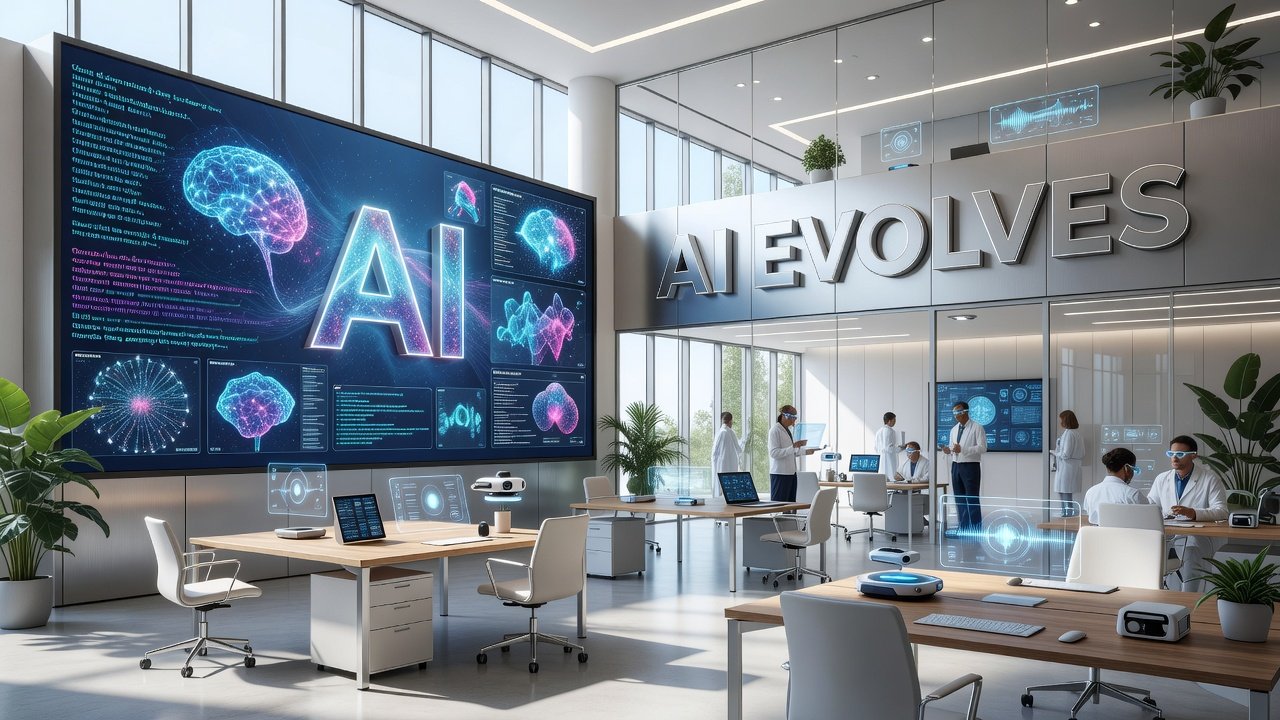
Chatbots have become our daily companions - answering questions, drafting emails, and helping with research. But they're just the beginning. The next wave of artificial intelligence is moving beyond simple question-and-answer interactions toward systems that can plan, reason across multiple steps, and integrate so deeply into our tools that we won't even notice they're there. This shift represents a fundamental change in how AI will shape our lives, moving from novelty applications to invisible infrastructure that powers everything from scientific breakthroughs to the apps on your phone.
Agentic AI: Systems That Think Several Steps Ahead
The biggest leap forward isn't making chatbots smarter - it's building AI that can actually execute complex tasks without constant hand-holding. This is what researchers call agentic AI, and it's a completely different animal from the conversational tools you're used to.
Instead of waiting for you to prompt it at every turn, agentic AI can plan a multi-step process, make contextual decisions along the way, and adjust its approach when something doesn't work. Think of it like the difference between giving someone turn-by-turn directions versus simply telling them the destination and letting them figure out the best route, including detours around traffic.

In practical terms, this means AI systems that can manage your entire travel itinerary - not just suggesting hotels, but booking them, coordinating transportation, adjusting for delays, and handling cancellations. Or consider a research assistant that doesn't just summarize papers but identifies gaps in existing literature, proposes new experiments, and even helps design the methodology.
The key difference? These systems maintain context over time and across different types of tasks. They understand goals, not just queries. When you ask a chatbot for help planning a party, it gives suggestions. An agentic system would create the shopping list, order supplies from different vendors to get the best prices, send calendar invites, and follow up with guests who haven't responded.
AI Snapshot: GNoME, an AI system focused on materials science, has unveiled over two million new crystal structures, dramatically expanding the known possibilities for materials that could be used in everything from batteries to semiconductors.
Multimodal Intelligence: AI That Sees, Hears, and Creates Across Formats
Text-based chatbots feel limited because that's exactly what they are. The next generation of AI doesn't just read and write - it processes the world the way humans do, across multiple senses and formats simultaneously.
Multimodal AI can analyze a medical scan image, read the patient's history, listen to the doctor's verbal notes, and synthesize all of that into a diagnostic recommendation. It can watch a video of a manufacturing process, identify inefficiencies, and generate both a written report and a new instructional video showing the improved workflow.
This isn't about bolting separate tools together. Modern multimodal systems understand the relationships between different types of information in ways that create entirely new capabilities. When you show such a system a photo of your refrigerator contents and ask what you can make for dinner, it's simultaneously doing image recognition, nutritional analysis, recipe matching, and natural language generation - all in a single, coherent process.
The entertainment industry is already seeing this shift. Directors can describe a scene verbally, sketch it roughly on a tablet, and have AI generate storyboards that combine their visual style preferences with the narrative requirements. Musicians can hum a melody, describe the mood they want, and receive a full arrangement that matches their vision.
What makes this transformative is the elimination of translation steps. You don't need to convert your visual idea into words, then those words into design specifications. The AI works with whatever input makes sense for your thought process.
AI in Healthcare and Scientific Discovery: Real-World Breakthroughs
Medicine and research are where AI's evolution beyond chatbots becomes most tangible. We're seeing systems that don't just assist scientists but actively accelerate the pace of discovery in ways that weren't possible before.
In healthcare, AI now participates in early diagnosis by analyzing patterns across millions of patient records, imaging studies, and genetic profiles. It's synthesizing new drug compounds by predicting how different molecular structures will interact with disease targets - a process that traditionally took years of lab work. Some systems generate synthetic medical data that preserves patient privacy while giving researchers the datasets they need to train better diagnostic tools and improve clinical trials.
The speed difference is staggering. GraphCast, a weather prediction AI, delivers highly accurate 10-day forecasts in under a minute - a task that would take traditional supercomputer models hours. That's not just convenient; it means meteorologists can run hundreds of scenarios to better understand extreme weather risks, potentially saving lives through earlier warnings.
Materials science is experiencing a similar revolution. Beyond the millions of crystal structures discovered by GNoME, AI systems are predicting the properties of materials that have never been synthesized, guiding researchers toward compounds that could make batteries last longer, solar panels work more efficiently, or create entirely new classes of superconductors.
These aren't incremental improvements - they're fundamental shifts in how research happens. Scientists increasingly work alongside AI partners that can process vastly more information than any human team, identify patterns that would otherwise remain hidden, and propose hypotheses that challenge conventional thinking.
Invisible AI: When Intelligence Becomes Infrastructure
Here's where things get really interesting - and perhaps counterintuitive. The future of AI might be its disappearance from view.
Many experts predict that AI will become so thoroughly integrated into our everyday applications that we'll stop thinking of it as a separate thing. You won't open "the AI app" - your email will just get smarter about understanding context and suggesting responses. Your browser will naturally help you research topics without you needing to prompt it. Your calendar will negotiate meeting times with other people's calendars, accounting for everyone's preferences and constraints.
This invisibility doesn't mean the AI is less powerful. It means it's more useful. Consider how spell-check works now - you don't think about it as artificial intelligence, even though it absolutely is. It's just part of writing. That's the template for where all of AI is headed.
Your phone's camera already uses AI to adjust settings, recognize scenes, and enhance photos. Soon, that same invisible intelligence will help you remember where you parked, remind you to buy milk when you're near the grocery store, and automatically organize your photos by the people and places that matter to you - all without you installing a special app or learning new commands.
The shift represents a maturation of the technology. Early AI needed to be flashy and obvious because it was novel. Mature AI fades into the background, becoming infrastructure rather than spectacle. The most successful technologies often become invisible - we don't marvel at electricity anymore, we just expect it to work.
Conclusion
The chatbot era taught us that AI could understand and generate language at a human level. That was impressive, but it was also just the foundation. What's coming next - agentic systems that plan and execute, multimodal intelligence that thinks across formats, scientific tools that accelerate discovery, and invisible AI woven into everyday applications - represents a fundamentally different relationship with artificial intelligence.
We're moving from AI as a tool you consult to AI as infrastructure you rely on. From systems that respond to systems that anticipate. From technology you need to learn to technology that learns you. This transition won't happen overnight, and it won't be without challenges. But the direction is clear: AI is evolving from a conversational partner into an operational fabric that supports how we work, discover, and live. The question isn't whether this future arrives, but how thoughtfully we build it.
FAQs
What is agentic AI and how is it different from chatbots?
Agentic AI can plan and execute multi-step tasks with minimal human intervention, making contextual decisions along the way. Unlike chatbots that respond to individual prompts, agentic AI maintains goals across complex processes - like managing an entire project rather than just answering questions about it. Think of it as the difference between a consultant who gives advice and a project manager who actually gets things done.
Will AI replace scientists and researchers?
No, AI is augmenting scientific work rather than replacing it. Systems like GraphCast and GNoME accelerate specific tasks - running predictions, identifying patterns, proposing compounds - but human researchers still design experiments, interpret results in broader contexts, and make judgment calls about what questions matter. AI is becoming a powerful research partner, not a replacement for human curiosity and creativity.
What does multimodal AI mean in practical terms?
Multimodal AI can process and generate content across different formats - text, images, audio, video - in a single, integrated system. Practically, this means you can show it a photo and get a written description, describe something verbally and receive a visual design, or provide rough sketches that it converts into polished videos. It eliminates the need to translate your ideas between different formats manually.
How will invisible AI change daily technology use?
Invisible AI means intelligence becomes built into the tools you already use rather than requiring separate applications. Your email will automatically understand context and priorities, your calendar will handle scheduling negotiations, and your phone will anticipate needs based on your routine - all without you consciously interacting with "an AI." The technology becomes infrastructure you rely on without thinking about it, similar to how autocorrect works today.
Author

Maya-Rodriges@foucheres.com