
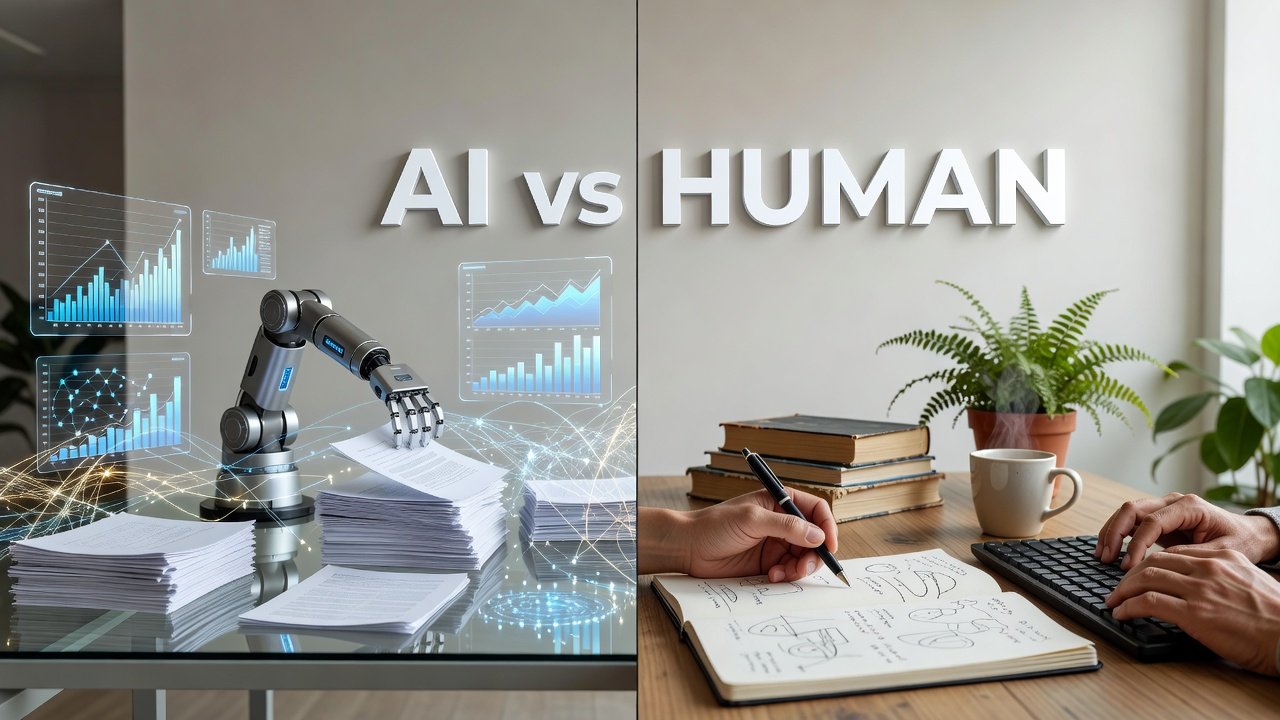
Every business leader today faces the same dilemma: which tasks should you hand to AI, and which ones absolutely need a human behind them? Getting this decision wrong can cost you time, money, and customer trust. The good news is that AI and humans each have distinct strengths, and understanding where those boundaries lie can transform how you work. AI excels at speed, precision, and consistency, while humans bring emotional intelligence, ethical judgment, and creative thinking. The secret to success isn't choosing one over the other, but knowing exactly when to use each.
Where AI Shines: Tasks It Handles Better Than Humans
AI has become remarkably good at certain types of work, particularly anything involving large volumes of data or repetitive processes. When you need to analyze thousands of customer records, spot patterns in sales data, or process information faster than any human could, AI is your answer. It doesn't get tired, doesn't lose focus, and maintains the same level of accuracy whether it's the first task or the thousandth.
Data analysis stands out as one of AI's strongest capabilities. AI tools can process vast amounts of information to identify trends, detect anomalies, and generate insights in minutes rather than days. This includes predictive analytics where AI forecasts future trends and prescriptive analytics where it recommends specific actions for better business outcomes. The technology automates data cleaning, processing, and reporting, which reduces operational costs and accelerates the time to insight.

AI Snapshot: AI models like Claude can function as an entire development team, writing code, debugging complex technical issues, and even reprogramming hardware devices.
Content creation represents another area where AI delivers real value. You can use AI to generate ideas, draft blog posts, create social media updates, write email campaigns, and optimize existing content for clarity, tone, and SEO. Tools like ChatGPT excel at natural language processing tasks, including drafting professional emails, generating itineraries, explaining complex concepts, and helping weigh pros and cons for decisions. The key is understanding that AI produces strong first drafts, but you'll need human editing to ensure the content sounds authentic and matches your brand voice.
Customer service automation has transformed how businesses handle routine inquiries. AI chatbots and agents provide 24/7 availability, handle repetitive questions, route requests intelligently, and equip human agents with real-time context. By analyzing customer interactions, AI can predict customer needs and suggest proactive measures to improve satisfaction. This frees your human team to focus on complex issues that require empathy and nuanced problem-solving.
Administrative tasks that once consumed hours of employee time can now be automated. AI handles email drafting, document summarization, scheduling, and data reconciliation with ease. Microsoft Copilot, embedded in Microsoft 365 applications, automates routine work, drafts content, and surfaces insights from organizational data within applications like Teams, Outlook, and Word. It can transform Excel data into PowerPoint presentations, import tasks from DevOps, and generate meeting summaries in multiple languages.
The Human Touch: Tasks That Still Need People
While AI handles structured, data-driven work brilliantly, there are critical business functions where human judgment remains irreplaceable. Complex decision-making and strategic thinking require the kind of nuanced judgment that AI simply cannot provide. When you face novel situations, ambiguous circumstances, or decisions with significant ethical implications, you need human oversight.
Creativity and original insights represent a fundamental limitation of current AI systems. AI can assist in creative processes by generating variations, suggesting combinations, or producing drafts based on existing patterns. However, it cannot manufacture truly original, point-of-view insights that come from lived experience and unique perspective. Your most innovative ideas, breakthrough strategies, and distinctive brand voice still need to come from human minds.
Emotional intelligence and genuine empathy separate human interactions from AI-generated responses. AI can simulate empathetic language patterns, but it lacks the authentic emotional understanding that builds real connections. When customers face sensitive issues, when employees need support during difficult times, or when stakeholders require reassurance during uncertainty, human presence makes all the difference. These moments demand the kind of emotional attunement that comes from shared human experience.
Ethical judgment and accountability pose another clear boundary. AI systems operate based on programmed rules and training data, lacking the capacity for moral reasoning or personal accountability that humans possess. Human oversight is critical for irreversible actions and ethical considerations that affect people's lives, livelihoods, or wellbeing. You cannot delegate moral responsibility to an algorithm.
Final verification and quality control require human judgment, particularly for critical or sensitive content. While AI produces impressive drafts and analysis, you need human review to ensure factual accuracy, brand voice consistency, and overall quality. AI can confidently state incorrect information, miss cultural nuances, or produce content that technically answers a prompt but misses the actual intent. Your final check catches these issues before they reach customers or stakeholders.
The Right Tool for the Right Job: Practical Guidelines
Making smart decisions about AI versus human work starts with understanding the nature of each task. Ask yourself whether the task is primarily rule-based or requires judgment. Can it be broken into clear steps, or does it need flexible thinking? Does it involve standard processes or unique circumstances?
For tasks that involve high volume and low variability, AI typically outperforms humans. Think about processing expense reports, categorizing support tickets, transcribing meetings, or extracting data from forms. These jobs follow predictable patterns and benefit from AI's consistency and speed.
When stakes are high and consequences are significant, lean toward human decision-making with AI support. Let AI gather the data, identify patterns, and present options, but keep a human in the loop for the final call. This hybrid approach combines AI's analytical power with human wisdom and accountability.
Consider the context and constraints of your specific situation. Microsoft Copilot's effectiveness depends heavily on the context, data, and instructions provided. Claude's outputs become most useful when configured to understand specific business contexts, products, tone, and customers. ChatGPT requires final editing to ensure personalization and avoid sounding generic. Each AI tool needs proper setup and human guidance to deliver value.
Build feedback loops where humans review AI outputs and improve the system over time. This iterative process helps you refine prompts, adjust parameters, and identify edge cases where AI struggles. The goal is not to achieve perfect AI performance, but to establish reliable collaboration between human and machine capabilities.
Conclusion
The question isn't whether AI will replace human workers, but how to combine both effectively. AI handles speed, scale, and consistency better than any human can. It processes data faster, works around the clock without fatigue, and maintains precision across thousands of repetitive tasks. Humans bring creativity, emotional intelligence, ethical judgment, and the ability to navigate ambiguity that AI cannot match.
The businesses that thrive will be those that deploy AI where it excels while preserving human involvement in areas that require judgment, empathy, and accountability. Start by identifying your most time-consuming repetitive tasks and experimenting with AI automation. Monitor the results closely, refine your approach, and gradually expand AI's role as you learn what works.
Remember that AI is a tool, not a replacement for human thinking. Use it to amplify your team's capabilities, free them from mundane work, and give them more time for the uniquely human contributions that drive real business value. The future of work isn't human versus machine, it's human and machine working together, each doing what they do best.
FAQs
Can AI completely replace human customer service representatives?
AI can handle routine customer inquiries, provide instant responses 24/7, and resolve common issues without human intervention. However, complex problems, emotionally charged situations, and cases requiring nuanced judgment still need human representatives. The most effective approach combines AI chatbots for initial contact and routine questions with human agents for escalated or sensitive issues. This hybrid model delivers both efficiency and empathy.
How do I know if a task is too complex for AI?
Tasks that involve unclear rules, ethical considerations, creative originality, or emotional intelligence typically exceed current AI capabilities. If a task requires you to read between the lines, consider cultural context, make judgment calls based on incomplete information, or take personal accountability for the outcome, it needs human involvement. Tasks with clear inputs, defined processes, and measurable outputs are generally good candidates for AI automation.
What happens if I rely too heavily on AI for content creation?
Over-reliance on AI for content can result in generic output that lacks authentic voice, original perspective, and emotional resonance. AI-generated content often follows predictable patterns that readers recognize and disengage from. While AI excels at creating first drafts, brainstorming ideas, and optimizing existing content, human editing and creative direction remain essential for content that truly connects with your audience and differentiates your brand.
Should I train my team to work with AI tools?
Absolutely. Training your team to use AI effectively is becoming as essential as training them on any other business software. They need to understand what AI can and cannot do, how to write effective prompts, how to verify AI outputs, and when to override AI suggestions. Investing in AI literacy helps your team leverage these tools productively while avoiding common pitfalls like accepting inaccurate information or delegating tasks that require human judgment.
Author

Maya-Rodriges@foucheres.com
Related Posts

Using AI to Spot What Customers Will Want Next Season
Discover how AI predict customer trends before they happen, helping businesses forecast demand, optimize inventory, and deliver what shoppers want faster.
Read out all
How Frequent AI Model Releases Change Company Buying
Rapid AI model releases are transforming enterprise procurement from capital investment to recurring cost. Learn how companies adapt to constant updates.
Read out all
From Pilot to Production: Making AI Stick at Work
Only 12% of AI pilots reach production. Learn why most AI projects fail to scale and how to design an AI implementation...
Read out all
Hidden Costs of Running AI in Your Business 2026
Hidden costs of AI can balloon to 200-300% beyond vendor quotes. Learn what businesses really spend on data prep, infrastructure, security, and...
Read out all
How Small Teams Use AI to Do the Work of Ten
Discover how small teams use AI tools to automate tasks, save hours daily, and compete with larger companies while staying lean and...
Read out all
Why Every Small Business Needs an AI Strategy Now
Small businesses using AI gain efficiency, better decisions, and competitive advantages. Learn why developing an AI strategy in 2026 is essential for...
Read out all