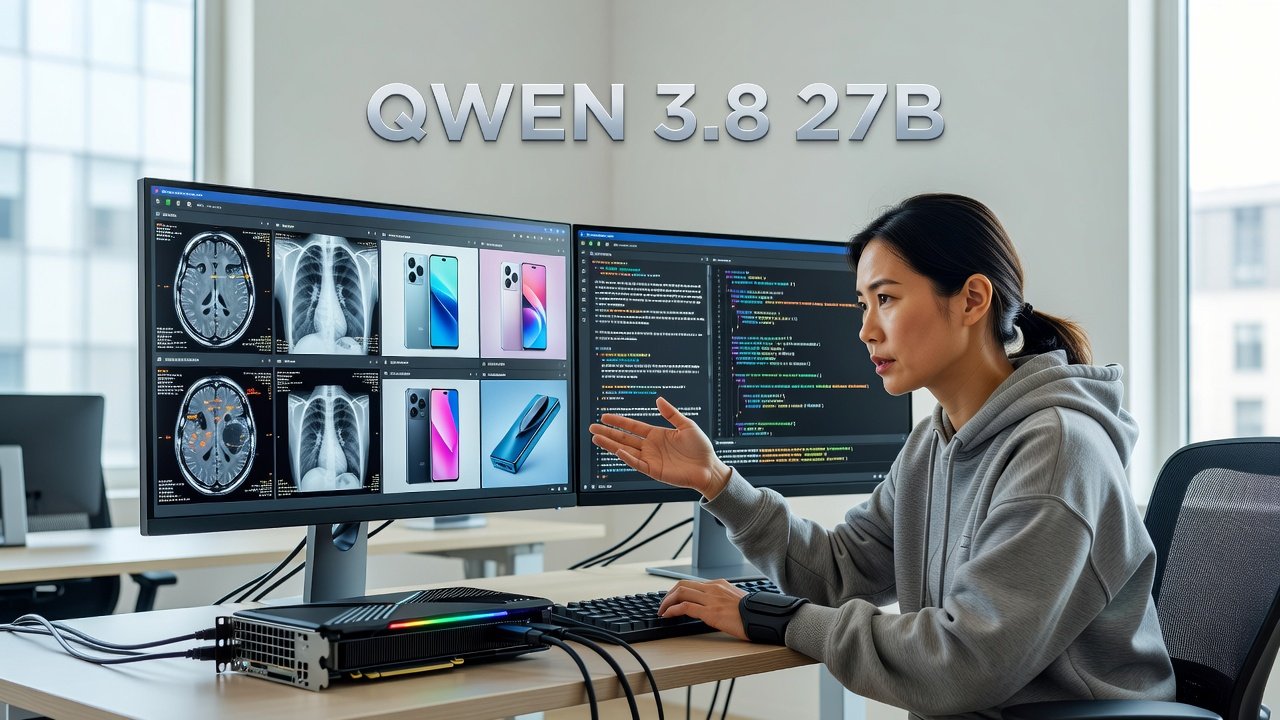
Alibaba's cloud division has just dropped Qwen 3.8 27B, a multimodal AI model that brings together vision processing, an enormous context window, and a fully permissive open-source license. Released on August 14, 2026, this model doesn't just process text - it understands images and video, handles up to 262,144 tokens natively (expandable to 1 million), and ships under Apache 2.0, meaning you can use it commercially, modify it, and redistribute it without licensing headaches. For developers who've been waiting for a capable multimodal model that won't lock them into proprietary ecosystems or drain their GPU budgets, Qwen 3.8 27B arrives at exactly the right moment. The quantized versions can run on a single consumer GPU with just 17GB of RAM, putting serious AI capabilities within reach of individual developers and small teams.
What Makes Qwen 3.8 27B Different
The standout feature here is the integrated vision encoder. Unlike text-only models that require separate systems to process images, Qwen 3.8 27B handles both modalities natively. You can feed it a medical scan alongside patient notes, a product photo with technical specs, or surveillance footage with incident reports, and it processes everything together in a single inference pass.
That native 262,144-token context window is massive. For reference, that's roughly 200,000 words or about 400 pages of a typical novel. Most competing models in this size range cap out at 32,000 or 64,000 tokens. When you need to analyze entire codebases, long legal documents, or multi-hour video transcripts, those smaller windows force you to chunk your data and lose coherence. Qwen 3.8 27B swallows these tasks whole.
The Apache 2.0 license removes the friction that has slowed adoption of other capable models. You don't need to negotiate commercial terms, worry about derivative works, or parse vague "research only" clauses. Build a product, sell it, modify the weights - it's all permitted. This matters especially for startups and enterprises who can't afford legal uncertainty in their AI stack.
AI Snapshot: Qwen 3.8 27B's quantized versions require approximately 17GB of RAM, enabling deployment on a single consumer-grade GPU rather than enterprise server infrastructure.
The Technical Architecture Behind the Performance
Alibaba built this model on a transformer architecture optimized for multimodal inputs. The vision encoder doesn't just tag images with labels - it creates dense embeddings that capture spatial relationships, object interactions, and visual context. When you ask it to analyze a floor plan and suggest furniture placement, it understands both the geometry and the functional constraints.
The context window extension through YaRN (Yet another RoPE extensioN) scaling is particularly clever. RoPE (Rotary Position Embedding) helps transformers track token positions in long sequences, but standard implementations degrade rapidly beyond their training length. YaRN modifies how position information scales, allowing the model to extend from 262K to 1M tokens while maintaining coherence. In practice, this means you can process feature-length films, entire textbooks, or sprawling email threads without performance collapse.
The 27-billion-parameter count hits a sweet spot. Smaller models sacrifice capability; larger ones demand GPU clusters that most organizations can't justify. At 27B parameters, with 4-bit or 8-bit quantization, you can run inference on hardware that developers already own. An RTX 4090 with 24GB VRAM handles it comfortably. Even an RTX 3090 with 24GB works, though with tighter memory margins.
Quantization trades a small amount of precision for massive memory savings. The original model in full precision requires around 54GB of memory (27 billion parameters × 2 bytes per parameter). Quantizing to 8-bit halves that to 27GB; 4-bit quantization cuts it to roughly 14GB, fitting easily within consumer GPU bounds. The performance hit is surprisingly small - most benchmarks show single-digit percentage drops in accuracy.
Real-World Applications Already Emerging
Healthcare organizations are testing Qwen 3.8 27B for diagnostic assistance. A radiologist can upload an MRI scan, attach the patient's symptom history and lab results, and ask the model to identify anomalies or suggest differential diagnoses. The vision processing catches subtle patterns in imaging data while the text understanding contextualizes those patterns against medical literature and patient history.
Content moderation teams at mid-sized social platforms are deploying it to review flagged posts. Instead of separate systems for text toxicity detection and image classification, they run everything through one model that understands how text and images combine to violate policies. A meme with benign text but hateful imagery gets caught; so does a seemingly innocent photo with coded harassment in the caption.
Legal tech startups are using the extended context window for contract analysis. Upload a 500-page merger agreement, reference documents, and regulatory guidance, then ask for inconsistencies or compliance gaps. The model holds all of it in working memory and can trace references across hundreds of pages without losing thread.
Developers building AI assistants for research appreciate the multimodal capability. A materials scientist can drop in electron microscope images, spectroscopy data as text, and published papers, then query about crystal structures or chemical compositions. The model synthesizes across data types instead of forcing the researcher to pre-process everything into text.
The Competitive Landscape and What This Changes
Qwen 3.8 27B competes directly with models like LLaVA, GPT-4 Vision, and Claude 3, but the licensing and resource requirements shift the economics. GPT-4 Vision charges per API call and keeps its weights closed. Claude 3 is similarly API-only. LLaVA is open-source but requires more complex setup and lacks the context window breadth.
The Apache 2.0 license specifically changes the calculus for commercial deployment. If you're building a SaaS product, running Qwen 3.8 27B on your own infrastructure means predictable costs that scale with compute, not with user volume or revenue. No usage tiers, no surprise bills when your product takes off, no vendor negotiating leverage over your margins.
For researchers, the open weights enable fine-tuning on domain-specific data. A geology department can train it on mineral identification from thin-section microscopy. A manufacturing company can specialize it for defect detection on their specific product line. This adaptability is impossible with closed models where you're limited to prompt engineering and few-shot examples.
The context window extension also addresses a pain point that has plagued long-document AI applications. When you're forced to chunk a 100,000-token document into smaller pieces, you lose cross-references, narrative flow, and coherence. Summarization becomes less accurate; question-answering misses context that appears pages away from the relevant passage. Qwen 3.8 27B's ability to handle these documents whole improves output quality substantially.
Conclusion
Alibaba's release of Qwen 3.8 27B marks a shift in what's accessible outside the major API providers. The combination of vision processing, massive context capacity, and permissive licensing delivers capabilities that were previously either closed-source expensive or open-source impractical. Running capable multimodal AI on consumer hardware with full commercial rights changes who can build serious AI products.
The model isn't perfect - quantization does reduce precision slightly, the 27B parameter count trails the largest frontier models, and community support is still developing compared to more established open-source projects. But for teams that need vision understanding, long-context processing, and deployment flexibility without vendor lock-in, Qwen 3.8 27B offers a compelling option.
What matters most is the signal this sends about the trajectory of open-source AI. Models with genuine multimodal capability, enterprise-grade context windows, and unrestricted commercial licenses are no longer theoretical future developments. They're here, they run on hardware you can buy, and they're licensed for real business use. That accessibility accelerates what small teams and individual developers can build, and it pressures closed providers to justify their pricing and restrictions against increasingly capable alternatives.
FAQs
What hardware do I need to run Qwen 3.8 27B locally?
You'll need a GPU with at least 17GB of VRAM for the quantized version, which means cards like the RTX 3090, RTX 4090, or equivalent. The full-precision model requires around 54GB, necessitating multiple GPUs or specialized hardware. Most users will run the 4-bit or 8-bit quantized versions on a single high-end consumer GPU. CPU inference is technically possible but impractically slow for production use.
How does the Apache 2.0 license differ from other open-source AI licenses?
Apache 2.0 is one of the most permissive licenses available. You can use Qwen 3.8 27B commercially, modify the weights, and redistribute your modified versions without requiring permission or sharing your changes. Some other open models use licenses that restrict commercial use, require revenue sharing above certain thresholds, or mandate that modifications remain open-source. Apache 2.0 removes all these restrictions, though you must still provide attribution and include a copy of the license.
Can Qwen 3.8 27B process video as well as images?
Yes, the model handles video through its vision encoder by processing individual frames and understanding temporal relationships between them. You can feed it video clips for tasks like action recognition, event detection, or content summarization. The performance depends on video length and resolution - longer videos may need sampling strategies or splitting across the context window, but the native multimodal architecture processes visual motion more effectively than text-only models working from transcripts alone.
How does the 262K token context window compare to other models?
Qwen 3.8 27B's 262,144-token native context significantly exceeds most comparable models. GPT-4 Turbo offers 128,000 tokens, Claude 3 ranges from 200,000 tokens depending on the version, and many open-source alternatives max out at 32,000 or 64,000 tokens. The extension to 1,000,000 tokens through YaRN scaling is experimental and may show quality degradation at the extreme upper range, but even the native 262K window handles use cases that would require chunking and reassembly with smaller-context competitors.
Author

Maya-Rodriges@foucheres.com
Related Posts
Voice AI Is Finally Good: Where It Actually Works
Voice AI has crossed the accuracy threshold. Discover where voice AI actually works now - from customer service to healthcare - and...
Read out all
OpenAI Agents API: Build AI Agents With Sessions
OpenAI's Agents API launched Sept 2026 with managed sessions, automatic context compaction, and flexible deployment for building long-running AI agents.
Read out all
Is AI Search Replacing Google? What the Numbers Say
Is AI search replacing Google? We analyze market share, usage patterns, and 2026 data to reveal what's really happening in the search...
Read out all
Slack Integrates AI Coding Agents Into Group Chat
Slack Code brings AI coding agents into team channels for collaborative development. Learn how this August 2026 launch changes software teamwork.
Read out all
This Week in AI: Major Model Releases and What They Mean
Google Gemini 3.5 Flash, GPT-5, and Claude 4.5 Sonnet redefine AI in 2026. Explore autonomous agents, multimodal capabilities, and what these releases...
Read out all
OpenAI vs Google vs Anthropic: AI Race Heats Up in 2026
OpenAI, Google, and Anthropic compete for AI dominance with different approaches. Compare their technology, funding, and strategies shaping AI's future.
Read out all